WordPress vs Shopify for E-commerce: The Ultimate Guide for Hills District Retailers in 2024
The Hills District is experiencing a digital transformation, with local retailers increasingly recognising the need for a robust online presence. From Baulkham Hills to Castle Hill, business owners are asking themselves a crucial question: should I build my online store with WordPress or Shopify? Our e-commerce solutions team at Cosmos Web Tech has helped dozens of local retailers navigate this important decision.
As the Cosmos Web Tech team has worked with dozens of Hills District retailers over the years, we’ve seen firsthand how the right e-commerce platform can make or break an online business. Our WordPress development services include comprehensive WooCommerce implementations for retailers who choose the WordPress path. Whether you’re running a boutique in Kellyville, a specialty store in Rouse Hill, or a service-based business in Blacktown, choosing between WordPress and Shopify is one of the most important decisions you’ll make for your digital future.
In this comprehensive guide, we’ll break down the key differences between these two powerhouse platforms, helping you make an informed decision that aligns with your business goals, budget, and technical capabilities.
Understanding the Fundamentals: WordPress vs Shopify
WordPress: The Flexible Giant
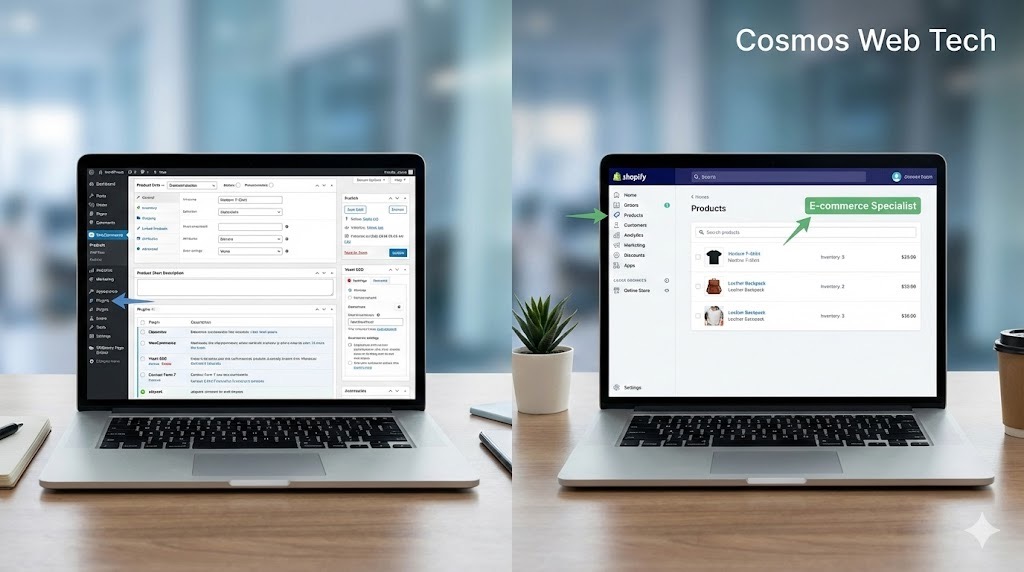
WordPress powers over 40% of all websites globally, and when combined with WooCommerce, it becomes a formidable e-commerce solution. WordPress is an open-source content management system that offers unlimited customisation possibilities. For Hills District retailers who want complete control over their online store’s appearance and functionality, WordPress presents an attractive proposition.
The platform’s flexibility means you can start with a simple store and gradually add features as your business grows. Local Hills District businesses like specialty food stores, home decor retailers, and professional services have found success with WordPress because it allows them to integrate blogging, service pages, and e-commerce functionality seamlessly.
Shopify: The E-commerce Specialist
Shopify, on the other hand, is a dedicated e-commerce platform designed specifically for online selling. It’s a hosted solution, meaning Shopify takes care of the technical infrastructure while you focus on running your business. For time-pressed Hills District retailers who want to get online quickly without dealing with technical complexities, Shopify offers an appealing all-in-one solution.
The platform has powered successful local businesses ranging from fashion boutiques to electronics retailers, providing them with professional-looking stores that work seamlessly across all devices.
Cost Analysis: What Hills District Retailers Can Expect
WordPress Costs: More Than Meets the Eye
While WordPress itself is free, running a professional e-commerce site involves several costs that Hills District retailers should consider:
Initial Setup Costs:
- Domain name: $15-30 annually
- Web hosting: $100-500 annually (depending on traffic and performance needs)
- SSL certificate: Often included with hosting
- Premium theme: $50-200 one-time
- Essential plugins: $100-500 annually
Ongoing Costs:
- Maintenance and updates: $50-200 monthly (if outsourced)
- Security monitoring: $50-150 annually
- Backup solutions: $50-150 annually
- Performance optimisation: Variable
For a typical Hills District retailer, the total first-year cost for a WordPress e-commerce site ranges from $500-2,000, with ongoing annual costs of $300-1,500.
Shopify Costs: Predictable Pricing
Shopify’s pricing structure is more straightforward, making it easier for Hills District business owners to budget:
Monthly Plans:
- Basic Shopify: $39/month
- Shopify: $105/month
- Advanced Shopify: $399/month
Additional Costs:
- Transaction fees: 2.9% + 30¢ (can be reduced with higher plans)
- Premium themes: $100-350 one-time
- Apps: $5-300 monthly depending on features needed
- Custom development: Variable
For most Hills District retailers, Shopify costs range from $600-2,000 in the first year, with predictable monthly expenses thereafter.
Ease of Use and Management: Time is Money
WordPress: Learning Curve with Long-term Benefits
WordPress requires a steeper initial learning curve, which can be challenging for Hills District retailers who are already juggling multiple business responsibilities. However, this investment in learning pays dividends in the long run.
Pros for Local Retailers:
- Complete control over content and design
- No monthly platform fees
- Extensive customisation options
- Strong SEO capabilities out of the box
- Large community support
Cons to Consider:
- Requires regular maintenance and updates
- Security is your responsibility
- Technical issues need troubleshooting
- Performance optimisation requires knowledge
Shopify: User-Friendly from Day One
Shopify shines in its simplicity and user-friendliness, making it particularly attractive for Hills District retailers who want to focus on selling rather than managing technology.
Pros for Local Retailers:
- Intuitive interface requiring minimal technical knowledge
- Built-in e-commerce features
- Automatic updates and security
- 24/7 customer support
- Mobile-responsive themes included
Cons to Consider:
- Monthly fees regardless of sales volume
- Limited customisation without coding knowledge
- Transaction fees on top of payment processor fees
- Platform dependency
Customisation and Design Flexibility
WordPress: Unlimited Possibilities
For Hills District retailers with specific branding requirements or unique business models, WordPress offers unparalleled flexibility. The platform supports thousands of themes and plugins, allowing for complete customisation of appearance and functionality.
Local success stories include a Baulkham Hills furniture store that integrated augmented reality features to help customers visualise products in their homes, and a Castle Hill wellness centre that combined appointment booking, e-commerce, and content marketing in one seamless platform.
Shopify: Professional Templates with Constraints
Shopify provides professionally designed themes that look great out of the box, but customisation options are more limited without coding knowledge. However, for many Hills District retailers, Shopify’s built-in features cover most requirements:
- Inventory management
- Order processing
- Customer accounts
- Mobile optimisation
- Payment gateway integration
A local Kellyville fashion boutique successfully launched with Shopify’s standard features and gradually added custom elements as their business grew.
Performance and SEO Considerations
WordPress: SEO Powerhouse with Performance Responsibilities
WordPress, particularly when optimised correctly, can deliver exceptional SEO results for Hills District retailers. The platform’s flexibility allows for comprehensive on-page optimisation, fast loading times, and excellent user experiences.
However, achieving optimal performance requires:
- Quality hosting selection
- Image optimisation
- Caching implementation
- Regular performance monitoring
Our team at Cosmos Web Tech has helped numerous Hills District businesses achieve first-page Google rankings with well-optimised WordPress sites.
Shopify: Reliable Performance with SEO Limitations
Shopify provides reliable, fast-loading websites with built-in mobile optimisation. The platform handles technical SEO basics well, but advanced optimisation can be limited compared to WordPress.
Shopify strengths include:
- Fast, reliable hosting infrastructure
- Mobile-first design
- Basic SEO features included
- Automatic sitemap generation
However, URL structure limitations and restricted access to certain technical elements can impact advanced SEO strategies.
Making the Right Choice for Your Hills District Business
Choose WordPress If:
- You have specific customisation requirements
- Content marketing is central to your strategy
- You want long-term cost control
- You have technical support available (or budget for it)
- SEO is a primary growth channel
- You’re planning to scale significantly
Ideal for: Service-based businesses, B2B companies, retailers with complex product catalogues, businesses requiring custom functionality.
Choose Shopify If:
- You want to launch quickly with minimal technical knowledge
- E-commerce is your primary focus
- You prefer predictable monthly costs
- You need reliable customer support
- Your product catalogue is straightforward
- You want built-in e-commerce features without plugins
Ideal for: Product-focused retailers, dropshipping businesses, fashion and beauty brands, businesses with straightforward selling models. 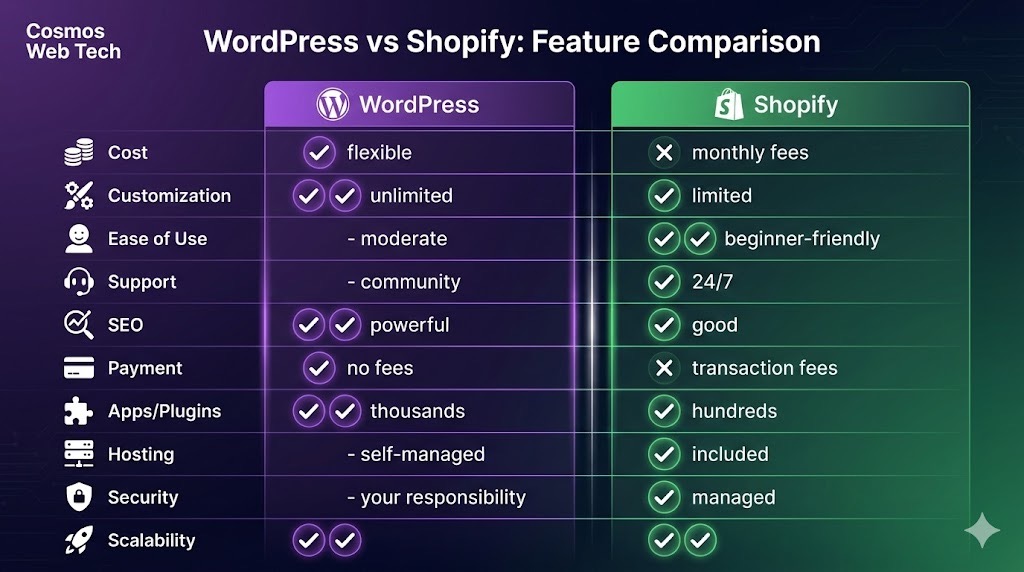
Conclusion: Your Path Forward
The choice between WordPress and Shopify isn’t about which platform is superior – it’s about which platform aligns best with your specific business needs, technical capabilities, and growth plans.
For Hills District retailers who prioritise flexibility, long-term cost control, and have access to technical support, WordPress with WooCommerce offers an excellent foundation for growth. However, if you need to launch quickly, prefer hands-off technical management, and want dedicated e-commerce features from day one, Shopify provides a robust, user-friendly solution.
Key Takeaways:
1. Budget for the real costs – both platforms have hidden expenses beyond the advertised prices 2. Consider your technical resources – WordPress requires more hands-on management 3. Think long-term – your choice will impact your business for years to come 4. Start with your goals – let your business objectives guide your platform decision 5. Get professional advice – consulting with experienced developers can save time and money
At Cosmos Web Tech, we’ve successfully implemented both WordPress and Shopify solutions for Hills District businesses. Our recommendation? Start with a clear understanding of your business goals, budget, and capabilities. From there, the right platform choice becomes much clearer.
Ready to take your Hills District business online? Contact our team for a personalised consultation where we’ll assess your specific needs and recommend the best path forward for your e-commerce success.
Modern retail runs on connected POS, inventory, and online channels. Cloud Geeks provides cloud and IT support that keeps Australian retail and hospitality businesses online during peak hours.
Ash Ganda covers digital strategy for retail and hospitality SMBs — what to automate, what to outsource, and where AI actually moves revenue.
Loyalty apps, mobile ordering, and customer-facing apps drive repeat business. Awesome Apps builds them for Australian retail and hospitality brands.
Part of the Ganda Tech Services family, Cosmos Web Tech delivers specialist web design and digital marketing for Australian small and medium businesses.